The Reality of Production Failures
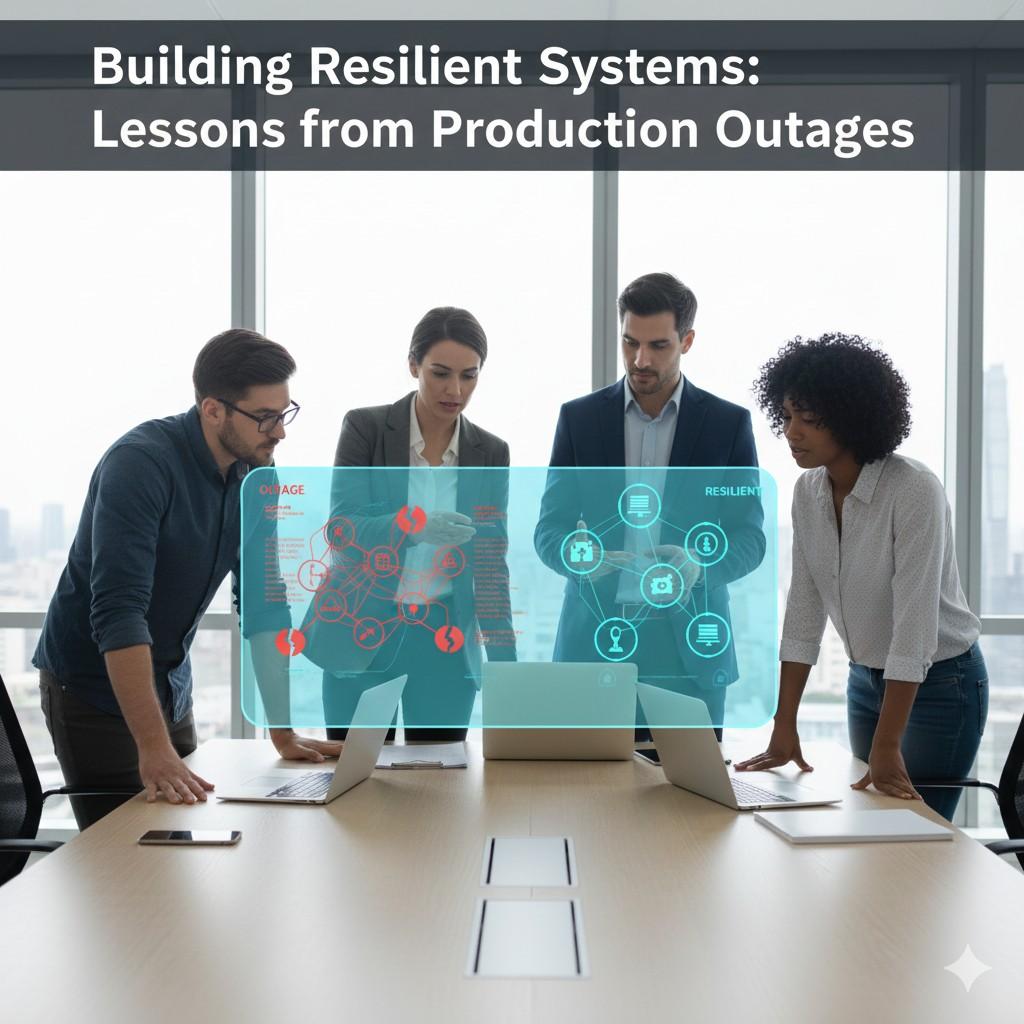
Every production system will eventually fail. Networks partition, servers crash, databases become unavailable, and bugs slip through testing. The question isn't whether failures will occur, but how your system responds when they do.
This guide distills lessons learned from analyzing hundreds of production incidents across various industries. We'll explore what makes systems resilient and how to design for failure from the start.
The Principles of Resilience
Embrace Failure as Normal
Traditional approaches try to prevent all failures. Resilient systems accept that failures are inevitable and design around them:
- Expect failures - Assume components will fail
- Detect quickly - Know when failures occur immediately
- Isolate impact - Prevent failures from cascading
- Recover automatically - Self-heal without manual intervention
Netflix's Chaos Engineering: regularly inject failures into production to verify your systems can survive them. If you're not breaking things intentionally, you'll break things accidentally.
Design for Degradation
Not all functionality is equally critical. Implement graceful degradation:
- Core features remain available even if auxiliary services fail
- Reduced functionality is better than complete outage
- Clear communication about degraded service
- Automatic recovery when services restore
Lessons from Real Outages
Lesson 1: Cascading Failures Are the Real Killer
Most major outages don't result from single component failures, but from cascades where one failure triggers others:
Example Scenario: Database slows down → Application threads pile up waiting → Application runs out of memory → Health checks fail → Load balancer removes all instances → Complete outage
Prevention Strategies:
- Implement timeouts on all external calls
- Use circuit breakers to stop calling failing services
- Set resource limits to prevent exhaustion
- Isolate failure domains
Lesson 2: Timeouts Are Non-Negotiable
Every external call must have a timeout. Without timeouts, slow services can bring down your entire system:
- Set aggressive timeouts (seconds, not minutes)
- Include timeouts for database queries
- Configure timeouts at multiple levels (application, load balancer, proxy)
- Test timeout behavior under load
Lesson 3: Retries Can Make Things Worse
Naive retry logic amplifies load on struggling services. Implement smart retries:
- Exponential backoff - Wait progressively longer between retries
- Jitter - Add randomness to prevent thundering herds
- Limited attempts - Cap retry count
- Idempotency - Ensure operations are safe to retry
Lesson 4: Monitoring Alone Isn't Enough
Many outages weren't detected by monitoring systems. Problems:
- Monitoring only checked symptoms, not user impact
- Alerts fired too late
- Alert fatigue led to ignored warnings
- Monitoring system itself failed
Solution: Implement synthetic monitoring that continuously validates critical user journeys:
- Can users log in?
- Can they perform key actions?
- Are response times acceptable?
- Monitor from multiple regions
Architectural Patterns for Resilience
Bulkheads: Isolate Failure Domains
Like compartments in a ship, bulkheads prevent failures from spreading:
- Separate thread pools for different services
- Dedicated resources for critical operations
- Tenant isolation in multi-tenant systems
- Regional isolation for global services
Redundancy and Replication
Eliminate single points of failure:
- Deploy across multiple availability zones
- Run multiple instances of every service
- Replicate data across regions
- Use active-active configurations when possible
Queue-Based Load Leveling
Queues buffer traffic spikes and protect downstream services:
- Absorb temporary load increases
- Enable asynchronous processing
- Provide natural backpressure
- Allow independent scaling of producers and consumers
Health Checks and Readiness Probes
Implement comprehensive health checking:
- Liveness probes - Is the service alive?
- Readiness probes - Can it handle traffic?
- Dependency checks - Are critical dependencies available?
- Startup probes - Has initialization completed?
Database Resilience
Connection Pool Management
Database connections are expensive resources. Manage them carefully:
- Set appropriate pool sizes (typically 10-20 connections per instance)
- Configure connection timeouts
- Implement connection validation
- Handle connection loss gracefully
Query Timeouts and Cancellation
Long-running queries can exhaust database resources:
- Set statement timeouts on all queries
- Cancel queries when client disconnects
- Implement query complexity limits
- Use read replicas for reporting queries
Backup and Recovery Testing
Backups you've never restored are worthless. Regular test recovery procedures:
- Restore backups to test environments weekly
- Measure Recovery Time Objective (RTO)
- Verify Recovery Point Objective (RPO)
- Practice point-in-time recovery
- Document and automate recovery procedures
Observability for Resilience
Distributed Tracing
Understand how requests flow through your system:
- Trace complete request paths
- Identify slow components
- Detect retry storms
- Understand failure propagation
Meaningful Metrics
Track metrics that matter:
- RED metrics - Rate, Errors, Duration
- USE metrics - Utilization, Saturation, Errors
- Business metrics - Successful transactions, revenue
- SLI metrics - Service Level Indicators tied to SLOs
Structured Logging
Logs should be machine-readable and queryable:
Chaos Engineering
Proactive Failure Testing
Don't wait for failures to happen. Cause them intentionally:
- Instance failures - Terminate random instances
- Network issues - Inject latency and packet loss
- Resource constraints - Exhaust CPU, memory, disk
- Dependency failures - Make external services unavailable
- Time manipulation - Test clock skew scenarios
Start Small, Build Confidence
Begin chaos experiments in controlled environments:
- Start in development/staging
- Define expected behavior
- Run experiments during business hours
- Have rollback plans ready
- Gradually increase blast radius
Incident Response
Clear Ownership and Escalation
Every service needs a clear owner:
- On-call rotations for 24/7 coverage
- Documented escalation paths
- Contact information readily available
- Incident commander role for major outages
Incident Management Process
Have a well-defined process for handling incidents:
- Detect - Identify the issue quickly
- Respond - Mobilize the response team
- Mitigate - Stop the bleeding
- Communicate - Keep stakeholders informed
- Resolve - Fix the root cause
- Learn - Conduct post-mortem
Blameless Post-Mortems
Focus on systems and processes, not individuals:
- Document timeline of events
- Identify root causes (usually multiple)
- Determine action items with owners
- Share learnings organization-wide
- Track action item completion
Testing for Resilience
Failure Mode Testing
Test specific failure scenarios:
- What happens if the database becomes read-only?
- How does the system behave with 50% packet loss?
- Can the application handle downstream service returning errors?
- What's the impact of filling up disk space?
Load Testing and Capacity Planning
Understand system limits before hitting them in production:
- Test at expected peak load
- Test at 2-3x expected load
- Identify bottlenecks and breaking points
- Measure degradation patterns
- Test sustained load over time
Conclusion
Building resilient systems requires a fundamental mindset shift: embrace failure rather than trying to prevent it entirely. Focus on quick detection, isolation of failures, and rapid recovery rather than attempting to prevent all failures.
Key takeaways:
- Design for failure from the start
- Implement timeouts, circuit breakers, and retries correctly
- Test failure scenarios regularly through chaos engineering
- Maintain comprehensive observability
- Learn from every incident through blameless post-mortems
Resilience is a journey, not a destination. Continuously test, learn, and improve your systems' ability to withstand and recover from failures.
Related Topics
Ryan Anderson
Site Reliability Engineer
Expert in cloud infrastructure and container orchestration with over 10 years of experience helping enterprises modernize their technology stack and implement scalable solutions.