The Evolution of CI/CD in Enterprise
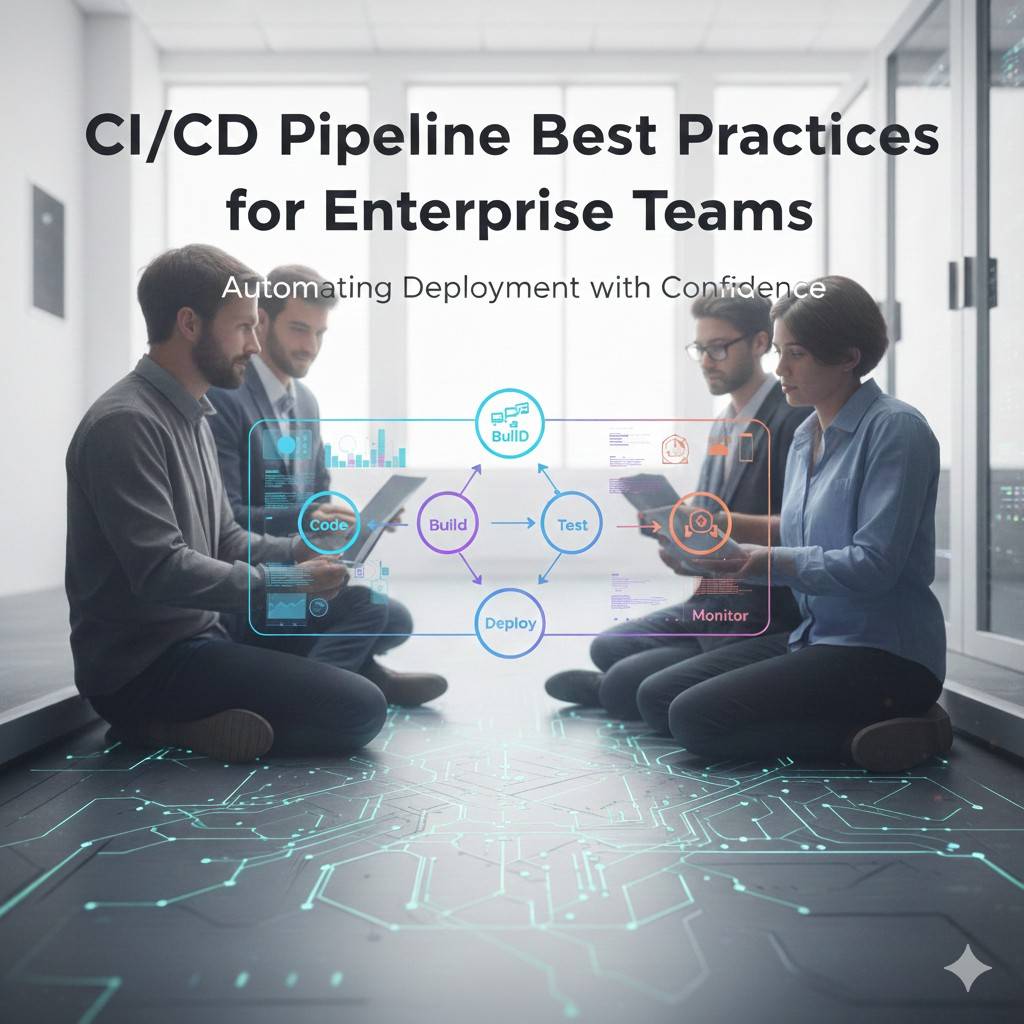
Continuous Integration and Continuous Deployment (CI/CD) has transformed from a best practice to an absolute necessity for modern software development teams. In enterprise environments, where multiple teams collaborate on complex systems, a well-designed CI/CD pipeline can be the difference between smooth, rapid deployments and chaotic, error-prone releases.
This guide covers proven strategies that leading enterprises use to implement robust, scalable CI/CD pipelines that support rapid development while maintaining quality and security standards.
Foundational Principles
Pipeline as Code
Your CI/CD pipeline configuration should be version-controlled alongside your application code. This approach, known as "Pipeline as Code," provides several critical benefits:
- Version Control - Track changes to your pipeline configuration over time
- Reproducibility - Recreate pipelines consistently across environments
- Code Review - Apply the same review process to pipeline changes as application code
- Documentation - The pipeline definition serves as living documentation
Treating your pipeline as code ensures that your deployment process is as reliable and maintainable as your application itself.
Single Source of Truth
All deployments should originate from your version control system. Never manually modify production environments. This principle ensures complete traceability and reproducibility of all changes.
Building a Robust CI Pipeline
Automated Testing Strategy
A comprehensive automated testing strategy is the backbone of any CI/CD pipeline. Implement a testing pyramid with these layers:
- Unit Tests - Fast, focused tests that validate individual components
- Integration Tests - Verify that components work together correctly
- End-to-End Tests - Validate complete user workflows
- Performance Tests - Ensure the system meets performance requirements
- Security Scans - Identify vulnerabilities early in the development cycle
Fast Feedback Loops
Optimize your pipeline for speed. Developers should receive feedback within minutes, not hours. Strategies include:
- Parallelize test execution wherever possible
- Use caching aggressively for dependencies and build artifacts
- Implement smart test selection to run only affected tests
- Utilize incremental builds when feasible
Deployment Strategies
Environment Progression
Code should progress through well-defined environments before reaching production. A typical progression includes:
Development → Testing → Staging → Production
Each environment should closely mirror production, with staging being nearly identical. This approach catches environment-specific issues before they impact users.
Deployment Patterns
Different situations call for different deployment strategies:
- Blue-Green Deployment - Maintain two identical environments, switch traffic instantly
- Canary Releases - Gradually roll out to a subset of users
- Feature Flags - Deploy code without exposing features, enable selectively
- Rolling Updates - Replace instances gradually to minimize risk
GitOps Methodology
Declarative Infrastructure
GitOps extends the principles of CI/CD to infrastructure management. Your Git repository becomes the single source of truth for both application and infrastructure state. When you commit changes to Git, automated processes synchronize the actual infrastructure to match the declared state.
With GitOps, your entire system state is version-controlled, auditable, and can be restored to any previous state with a simple Git revert.
Pull-Based Deployments
Instead of pushing changes from CI/CD tools, agents running in your cluster pull changes from Git. This approach enhances security by eliminating the need to expose cluster credentials to external CI systems.
Security and Compliance
Shift-Left Security
Integrate security checks early in the pipeline:
- Static Application Security Testing (SAST) during code analysis
- Dependency scanning to identify vulnerable packages
- Container image scanning before deployment
- Dynamic Application Security Testing (DAST) in staging environments
- Compliance validation against organizational policies
Secrets Management
Never commit secrets to version control. Use dedicated secrets management solutions like:
- HashiCorp Vault for centralized secrets management
- Cloud provider services (AWS Secrets Manager, Azure Key Vault)
- Kubernetes Secrets with external secret operators
Monitoring and Observability
Your CI/CD pipeline itself needs monitoring. Track metrics such as:
- Deployment Frequency - How often you deploy to production
- Lead Time - Time from commit to production
- Change Failure Rate - Percentage of deployments causing failures
- Mean Time to Recovery (MTTR) - How quickly you can recover from failures
Deployment Verification
Automatically verify deployments succeed:
- Smoke tests to verify basic functionality
- Health checks to ensure services are responding
- Synthetic monitoring to validate critical user paths
- Automatic rollback on failure detection
Enterprise-Scale Considerations
Multi-Team Coordination
In large organizations, multiple teams need to coordinate deployments. Implement:
- Shared pipeline templates and libraries
- Standardized deployment processes
- Clear ownership and responsibility boundaries
- Cross-team communication channels
Compliance and Audit Trails
Enterprise environments require comprehensive audit trails. Your CI/CD system should log:
- Who triggered each deployment
- What code changes were included
- When the deployment occurred
- What approvals were obtained
- What tests were executed and their results
Continuous Improvement
Your CI/CD pipeline should evolve continuously. Regularly review and optimize:
- Pipeline execution times
- Test coverage and effectiveness
- Deployment success rates
- Developer satisfaction and pain points
Conclusion
Implementing world-class CI/CD practices is a journey, not a destination. Start with the fundamentals—automated testing, consistent environments, and reliable deployments—then continuously refine your processes. The investment in robust CI/CD infrastructure pays dividends in deployment confidence, development velocity, and overall system reliability.
Our team has helped numerous enterprises transform their delivery pipelines. Contact us to learn how we can accelerate your CI/CD maturity journey.
Related Topics
Emma Williams
DevOps Lead
Expert in cloud infrastructure and container orchestration with over 10 years of experience helping enterprises modernize their technology stack and implement scalable solutions.