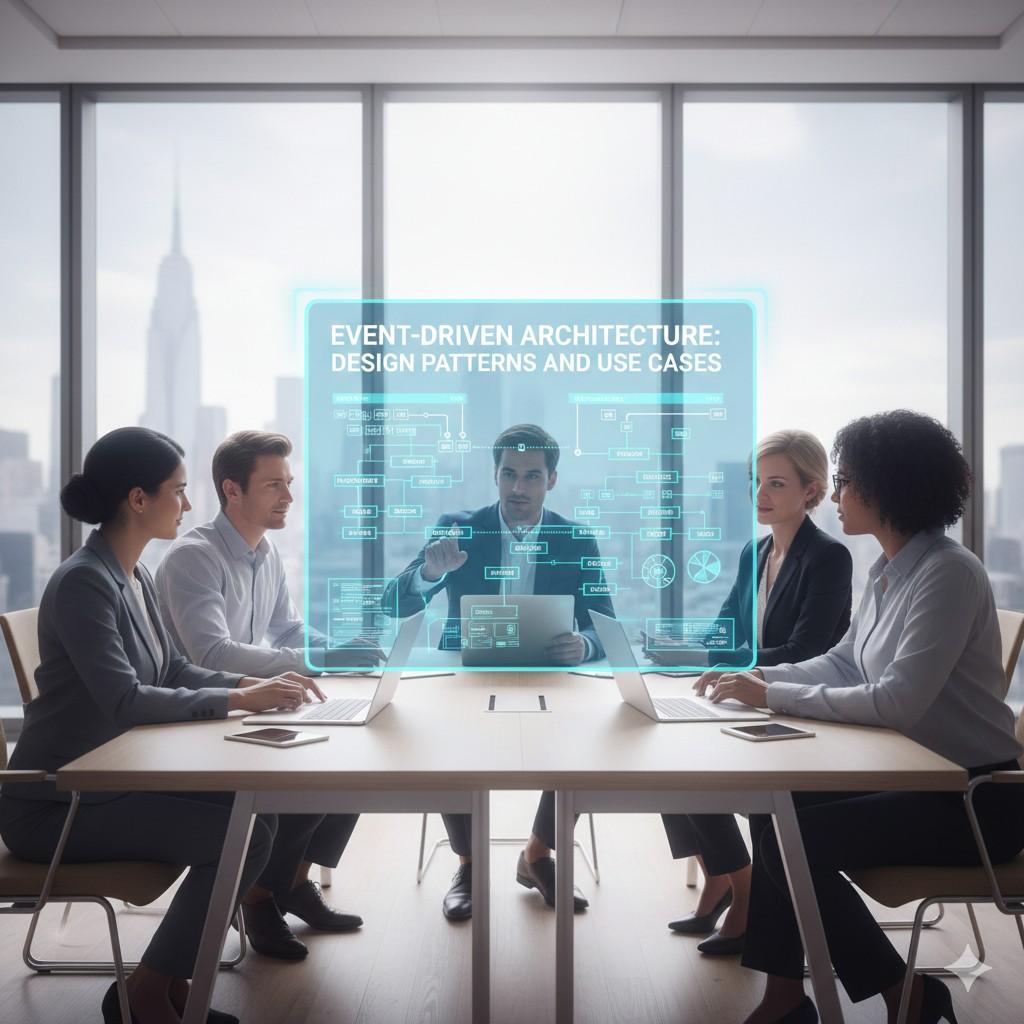
Understanding Event-Driven Architecture
Event-Driven Architecture (EDA) inverts the traditional request-response model. Instead of services directly calling each other, they communicate through events—notifications that something has happened. This decoupling enables systems to scale independently and handle complex workflows elegantly.
Core Concepts
Events vs Commands
Understanding the distinction is crucial:
- Commands - Requests for action ("PlaceOrder")
- Events - Notifications of facts ("OrderPlaced")
Events represent things that have already happened. Multiple consumers can react to the same event independently.
In event-driven systems, publishers don't know or care who consumes their events. This decoupling is both powerful and challenging.
Event Patterns
Event Notification
Lightweight events trigger actions in other services. The event contains minimal data; consumers fetch additional details if needed.
Event-Carried State Transfer
Events contain all necessary data. Consumers update their own state without querying the source.
Event Sourcing
Store events as the source of truth. Rebuild current state by replaying events.
Event Broker Technologies
Message Queues
- RabbitMQ - Flexible routing, mature
- AWS SQS - Managed, simple
- Azure Service Bus - Enterprise messaging
Event Streams
- Apache Kafka - High throughput, distributed
- AWS Kinesis - Managed streaming
- Azure Event Hubs - Big data ingestion
Choosing the Right Tool
Message queues for point-to-point messaging, event streams for high-volume, replay-able event logs.
Design Patterns
Publish-Subscribe
Publishers emit events to topics. Multiple subscribers receive copies:
Event Sourcing
Store events as the source of truth:
CQRS (Command Query Responsibility Segregation)
Separate read and write models. Commands modify state, queries read from optimized views updated by events.
Saga Pattern
Coordinate transactions across services using events:
- Each service completes its transaction
- Publishes success/failure event
- Next step triggered by event
- Compensating transactions for rollback
Benefits of Event-Driven Architecture
- Loose coupling - Services don't directly depend on each other
- Scalability - Process events asynchronously at your own pace
- Resilience - Services can be temporarily offline
- Extensibility - Add new consumers without changing publishers
- Audit trail - Events provide complete history
Challenges and Considerations
Eventual Consistency
Systems reach consistency eventually, not immediately. Design for this reality:
- Users may see stale data temporarily
- Implement retry mechanisms
- Handle duplicate events (idempotency)
- Communicate eventual consistency to users
Event Ordering
Events may arrive out of order. Strategies:
- Include timestamps and sequence numbers
- Use partitioning for ordering within a partition
- Design systems to handle out-of-order events
Debugging Complexity
Tracing requests across services is harder with events. Solutions:
- Include correlation IDs in all events
- Implement distributed tracing
- Comprehensive logging
- Event monitoring and visualization
Best Practices
Event Schema Design
Design events carefully—they're your contract:
- Use versioned schemas
- Include metadata (timestamp, correlation ID)
- Make events immutable
- Use semantic versioning
- Test schema evolution
Idempotency
Process the same event multiple times safely:
Dead Letter Queues
Handle events that fail processing:
- Automatically retry failed events
- Move to dead letter queue after max retries
- Monitor and investigate failures
- Manual intervention or reprocessing
When to Use Event-Driven Architecture
Good fits:
- Microservices architectures
- Systems with multiple independent workflows
- Real-time data processing
- Audit and compliance requirements
- High-scale, loosely coupled systems
Not ideal for:
- Simple CRUD applications
- Tightly coupled systems
- Requirements for immediate consistency
- Teams new to distributed systems
Conclusion
Event-Driven Architecture enables building highly scalable, resilient systems. The trade-off is increased complexity in debugging and reasoning about system behavior. Start with simple event patterns, implement robust monitoring, and evolve your architecture as you gain experience with EDA principles.
Related Topics
Zara Bennett
Solutions Architect
Expert in cloud infrastructure and container orchestration with over 10 years of experience helping enterprises modernize their technology stack and implement scalable solutions.